Stretching and strengthening
Stretching and strengthening.
We are born with an innate ability to harmonise and balance all the systems in the body. This never changes. With pain or dysfunction, there is never any need to introduce ‘extra’ strength to any part of the body as is so often advocated by physiotherapy. For instance if you have a painful knee, you are told to do lots of leg extensions and strengthen the quads (thigh muscles) to support the knee.. The theory, sounds intelligent, but is flawed. For several reasons:-
Firstly, how do you know your back is weak? How do you know your thigh muscles are weak? Aren't you just assuming that because it hurts in your back or your knee that therefore the muscles must be weak? Have you objectively determined that the muscle is indeed weak? Pain will make you unable to use a joint strongly, but that doesn't mean it's weak.
The body is designed to function harmoniously all the time, Muscles NEVER become weak without a reason. So you need to address the reason, not just arbitrarily try and strengthen them. If there is indeed a quantifiable weakness in the thigh or back or shoulder muscles, it is not because they need strengthening, it is because somewhere the body is out of balance. There are any number of kinetic chains (patterns of multiple muscle functions) that could lead to this weakness, but the purely symptomatic approach of strengthening a weak muscle is NOT the answer. Your Granny may not have a bad knee or back or shoulder, does that mean she has stronger muscles than you?
Also, there is the question of how to maintain the strength that you've gained. So even if strengthening a muscle fixed your problem (which it won't), the body is an adaptive mechanism, so if you stress it with weight lifting, the body will adapt by making our muscles stronger, but if you stop stressing the muscle with exercise it will quickly revert to it's normal 'everyday' strength.
We are all conditioned to believe ( by current medical practice) that pain is due to muscle weakness, and that if we just 'strengthened' our back it would stop hurting. Or if we strengthened our 'core' muscles then all would be well. We are also conditioned to believe that we must stretch tight muscles in order to bring them back to normal.
So most of us believe stretching and strengthening to be potential answers to all our problems.
So why doesn’t strengthening help my back/knee/shoulder/neck pain?
The short answer is simply that the problem is with the resting tone of the muscle, Not the length or the strength of the muscle. If the tone (the amount of contraction or tension in your muscle when you are resting) is too high, this will lead to a stress on its own boney attachments, and a natural inhibition or weakening of its opposing muscle. Normalising the overtoned muscle will allow the opposing muscle to regain it's normal strength almost immediately.
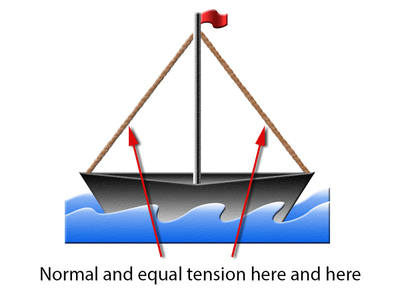 | 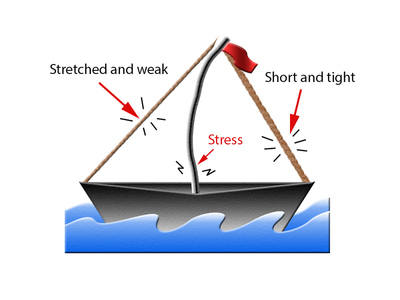 |
Now, look again at the ropes and the mast on the boat in the picture. Both ropes are taut, but if the ropes were muscles in our low back, which one would we see (or feel) to be the problem? If these were muscles which one would cause pain? The stretched taut and weak one or the short tight one?
Its actually the stretched taut and weakened muscle that is much more prone to pain and spasm. But because it feels tight and painful, its natural to assume that its short, taut and tight. So what do we do? We stretch it, and what happens to the already stretched and weakened muscle? Well at best nothing, and at worse it will go into even more of a spasm, if not during the stretch, then sometime afterwards.
Why?
Because the body is naturally designed to protect itself. Stretched, tired, tight, knotted and overworked muscle fibers quite simply find the added stretch an insult and in response go into even more of a protective spasm.
In fact the stretched, weak fibers simply cannot change until their opposing muscles which are short and tight, and often painless, are normalised. This is due to the law of reciprocal inhibition, which basically means that if one muscle contracts its opposing muscle must relax, so if you were to tighten your bicep to bend your arm, your brain will switch off your triceps because the job of triceps is to straighten the arm. Both muscles can't work at the same time. Now if a muscle is in a constant state of tension, then it's partner will be in a consistent state of relaxed or 'switched off' mode, it will eventually become weaker, and/or more prone to spasm when asked to work or stretch, culminating in what appears to be an even tighter muscle.
A good example is the tension people often experience in their upper back and trapezius muscles (the area from the shoulders to the neck) the underlying cause of this tension is short, tight chest muscles caused by occupational postures where the arms are constantly forward and the head is often forward bent. We can work on the tight, painful trapezius until the cows come home, but until we work on the chest muscles nothing is likely to effectively change.
With strengthening, we have to remember that in relation to any stress, the body tends to tighten muscles and connective tissue, not weaken them, weakness comes from a reciprocal reaction to these tensions, therefore trying to tighten and strengthen a weak muscle is never going to solve the problem. We are trying to force strength into an area that is only inhibited, or switched off, not actually weak.
So to reiterate, we do not get a weak muscle without reason, and to just identify weakness and arbitrarily try and strengthen it without questioning why it's weak is questionable.
Overall, I believe stretching and strengthening healthy muscles is great, it will keep the muscles healthy, supple and adhesion free. It will enhance our natural abilities enormously. But when used to try and rehabilitate chronically painful and tightened muscles, then the results are very likely to fall short of expectations.
*Note, with muscles in a high state of resting tone there is often no actual 'shortening' at all. Just the increased tone is capable of creating all the above effects. I see this often in dancers. It's easy to assume that because of a normal or excessive range of motion that there is no problem with the muscle. 'Long' muscles are not by definition 'healthy' muscles.